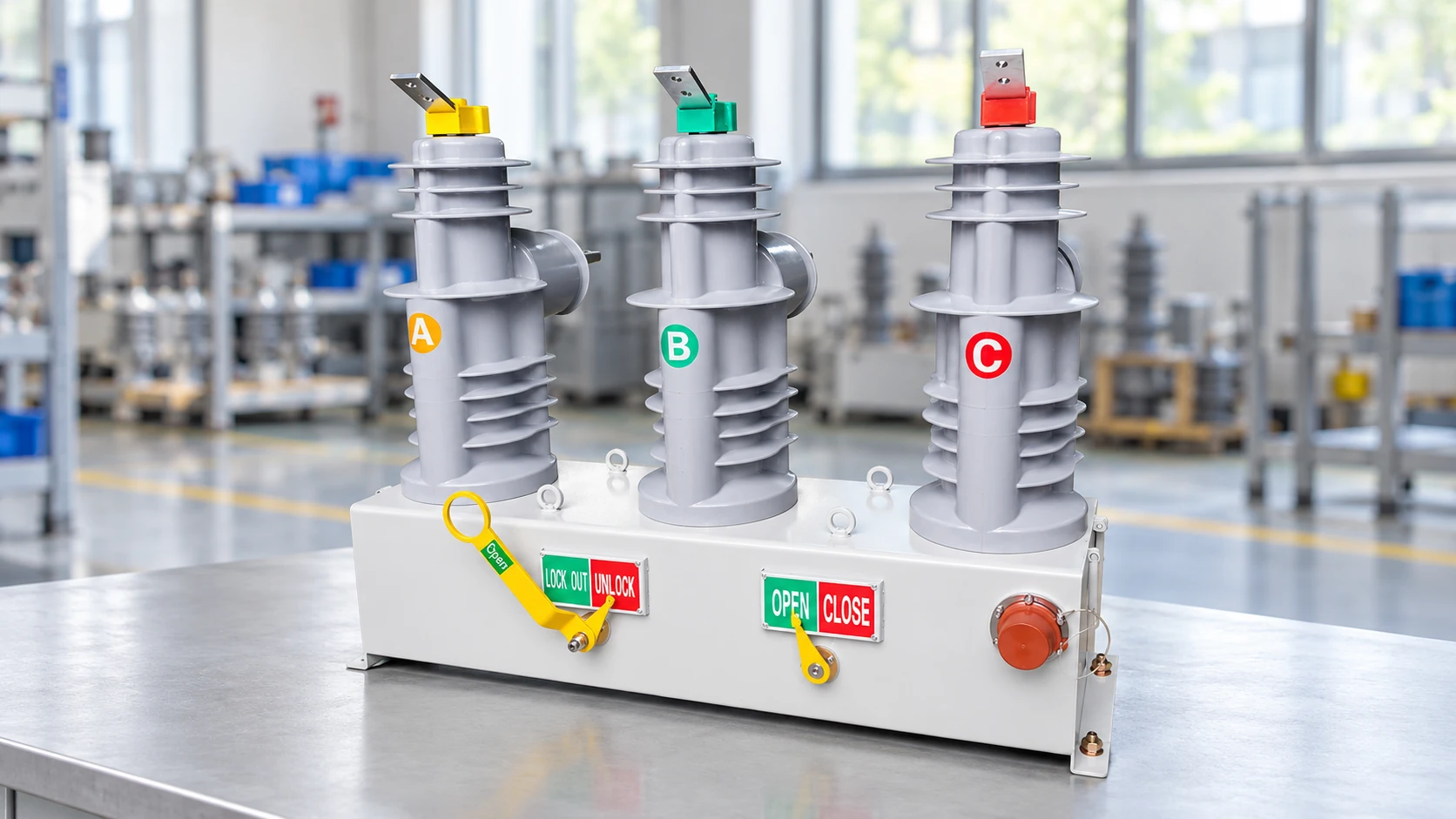
What is a high-voltage AC automatic recloser: how is it different from a "circuit breaker plus manual reclosing"?
Most overhead line trips are not permanent faults. Lightning flashovers, momentary tree branch contact, and wind-induced flashover discharges—the fault point often disappears by itself after the trip. But with a conventional circuit breaker, once it trips, the entire line loses power, and operation and maintenance personnel must arrive on site to confirm and then manually close the breaker; during this time, downstream users are all waiting.
The Qin Dian Zhi Cheng 15KV/27KV/38KV high-voltage AC automatic recloser addresses exactly this time gap: it covers three voltage levels—15kV, 27kV, and 38kV—and is aimed at the fault isolation and power supply restoration needs of overseas overhead lines.
How does it automatically trip and perform multiple reclosures to restore power when a transient fault occurs on the line?
The recloser turns "detection—tripping—waiting—reclosing" into a closed loop: when fault current appears, it trips and extinguishes the arc;after the deionization time elapses, it automatically recloses;If the fault persists and the breaker trips again, it enters the next reclosing cycle;if it still fails after reaching the set number of attempts, it locks out in the open position and waits for manual inspection. The point of this cycle is that a permanent fault will ultimately still require manual handling, but a transient fault no longer needs to wait for manual intervention. For scenarios such as urban distribution branch lines and long rural lines, where outage complaints are high and line patrol costs are high, what is reduced is precisely the portion of outages that "could have recovered on their own."
Why it cannot be treated as an ordinary circuit breaker with a reclosing accessory added
The difference is not in "whether reclosing is possible," but inwho completes this judgment and action。 Adding reclosing to an ordinary circuit breaker is essentially a combination of "circuit breaker body + external control logic": the circuit breaker is responsible for opening, and the reclosing logic is implemented by a relay protection device or control panel, with the two coordinated through secondary circuits. This scheme is feasible within a substation, but moving it to an overhead line means more secondary wiring, more coordination steps, and more on-site commissioning work.
A recloser, by contrast, integrates the breaking, reclosing logic, and count and time settings into a single device. The design orientation of this Qindian Zhicheng product is a simple structure with fewer parts, correspondingly longer mechanical life, and a protection rating and creepage distance designed for the outdoor overhead line environment—but this does not mean it is maintenance-free under all operating conditions; the specific maintenance cycle still needs to be confirmed based on the on-site environment. For overseas EPC contractors and switchgear manufacturers, this means one less set of secondary coordination, one less commissioning interface, and one less failure point on site.
A direct criterion for judgment:If your project site has complete protection panels and secondary design capability, the traditional scheme is not unfeasible;if what you want is pole-mounted installation, ready to use upon arrival, and reduced on-site wiring workload, then the recloser's level of integration is its true value.
27kV or 38kV: How do you walk through the four-step decision tree so you neither choose too high nor too low?
Between 27kV and 38kV there is no safer or superior choice; there is only whether it matches the line conditions. Qindian Zhicheng high-voltage AC automatic reclosers cover three voltage levels: 15kV, 27kV, and 38kV. Recloser voltage level selection can be done in four steps.
Step 1 to Step 4: rated voltage → system highest voltage and insulation level → altitude and pollution correction → match 15/27/38kV
Step 1: take the line rated voltage as the first anchor and confirm that the nominal voltage corresponds to the recloser rated voltage. Step 2: verify the system highest voltage and insulation level requirements. When the insulation level is not met, one cannot substitute a "higher voltage level" for item-by-item verification. Step 3: after the voltage level is determined, correct the external insulation and creepage distance according to the altitude and pollution level at the installation point.
Step 4: make the final match among the three levels of 15kV, 27kV, and 38kV.
- Select 27kVThe line is a 27kV system, and the insulation level still meets the requirements after altitude and pollution correction.
- Select 38kVThe line is a 38kV system, or the corrected 27kV configuration cannot cover the project insulation requirements.
- Not worth upgrading to a higher levelThe line is a 27kV system, the insulation level already meets requirements, and there is still margin after correction—at this point, upgrading only increases cost and structural complexity.
If the system's highest voltage, insulation level, or altitude and pollution data are missing, conclusions should not be drawn directly; operating condition data must be supplemented first before judgment.
Why "the higher the voltage level, the better" is a common misconception
A higher voltage level does not equal better protection performance. The core task of the recloser is to automatically trip and perform multiple reclosing operations to restore power when a transient line fault occurs; this depends on the coordination between protection settings and the controller and is unrelated to the rated voltage level. What truly needs margin is the insulation level and creepage distance, not the rated voltage itself.
Blindly choosing one level higher instead increases costs and the burden on spare-parts commonality.
Which scenarios are suitable for Qindian reclosers, and in which cases should additional information be gathered before making a judgment?
Qindian Zhicheng high-voltage AC automatic reclosers cover three voltage levels: 15kV, 27kV, and 38kV. Their core value lies in automatically tripping and performing multiple reclosing operations to restore power when a transient line fault occurs. To determine suitability, first look at the line voltage level, fault characteristics, and operating and maintenance conditions, then check whether the existing information can support insulation coordination and protection setting.
Key configuration points for collector lines in centralized photovoltaic and energy-storage booster stations
Collector lines in centralized photovoltaic and energy-storage booster stations have a high proportion of transient faults such as lightning strikes and wind deflection, and reclosing can reduce station outages, making them a typical application scenario for reclosers. However, attention must be paid to the coordination between reclosing impact and inverter low-voltage ride-through and protection settings; one cannot look only at the recloser itself. If the grid-connected line of the energy storage booster station requires rapid fault isolation and communication upload, it is also necessary to confirm that the controller protocol matches the station monitoring system.
For feeders of industrial self-supplied substations, the CT ratio and protection setting calibration must be confirmed first.
Protection and creepage distance correction for high-pollution coastal and long-distance rural lines
In high-pollution and coastal scenarios, priority should be given to product features such as large creepage distance and high protection rating, but conclusions must not be drawn based solely on "high protection rating." On-site pollution level, salt spray conditions, line nominal voltage, and maximum operating voltage must be supplemented to confirm whether the creepage distance and insulation level match. Long-distance rural lines are prone to lightning damage and have long patrol distances; similarly, the reclosing count setting must be confirmed in combination with line length, load characteristics, and the protection coordination scheme.
It should be noted that permanent faults cannot be restored by reclosing; the value of the recloser is concentrated on transient faults, while permanent faults still require protection isolation. The controller communication protocol and SCADA integration must be confirmed with Qindian Zhicheng on a project-by-project basis; full protocol compatibility is not assumed by default.
Pre-purchase self-check list: clarify voltage class, insulation level, and supporting requirements all at once
Once the voltage class is determined, what truly tends to cause rework during procurement is incomplete documentation: if line parameters are not fully provided, the insulation level cannot be verified;if the SCADA protocol is not clearly specified, the controller cannot be connected to the existing system after delivery. The following list is organized in the order of "primary equipment first, secondary integration second." After preparing each item, confirm the matching solution with Qindian Zhicheng; this saves more time than repeatedly going back and forth to supplement documents.
List of line and site information to be provided to Qindian Zhicheng
- System voltage and maximum operating voltage: Clearly specify whether it is the 27kV or 38kV class, and provide the system maximum operating voltage for verifying the insulation level, rather than looking only at the nominal voltage.
- Neutral point grounding method: Whether it is ungrounded, grounded through an arc suppression coil, or directly grounded directly affects insulation coordination and selection judgment.
- Environmental conditions at the installation point: Altitude, pollution level, lightning frequency, and ambient temperature range.The selection of creepage distance and protection level depends on these items, and they must be clearly stated especially for long rural lines and high-pollution areas.
- Basic line parameters: Rated current, short-circuit current level, feeder length, and the nature of the connected load, used to confirm whether the recloser's breaking capacity covers the actual operating conditions.
- Expected reclosing strategy: how many reclosing attempts are desired, whether coordination with upstream protection is required, and how instantaneous faults are distinguished from permanent faults.This determines the direction of controller setting configuration and also affects subsequent operation and maintenance practices.
- Installation and O&M conditions: whether pole-mounted or substation installation, available maintenance windows, and spare parts stocking plans, which relate to the structural form and long-term maintenance costs.
What conditions need to be confirmed for controller communication and SCADA integration?
The communication part is recommended to be locked down before quotation, not left until the delivery stage:
- Protocols supported by the existing SCADA: first list the protocol types already supported by the master station, then compare them against the interfaces the controller can provide, to avoid the situation where "the device can communicate but the master station does not recognize it."
- Physical interfaces and channels: Whether fiber optic, wireless, or serial, who provides the channel and whether additional communication equipment is needed—this part is often left out of the budget.
- Point table and information volume: Which telemetry, remote signaling, and remote control points need to be uploaded, and whether fault indication and reclosing action records need to be sent—defining the point table in advance can shorten the commissioning cycle.
- Coordination with existing protection: Who is responsible for CT ratios and protection setting calculations, and whether coordination tests with in-station protection devices are required.
Budget and complexity trade-offs
Give budget priority to primary equipment: the voltage level and insulation level must match the actual operating conditions of the line, and this item cannot be omitted. Next is communication protocol and SCADA compatibility, which is the foundation for grid connection and operations and maintenance. OEM customization and redundant communication configurations are optional items—if the project has no clear customization needs or dual-channel requirements, paying for redundant protocols and excessive customization will only lengthen the delivery cycle and increase debugging complexity.
Once the materials are complete, submit the above list to Qindian Zhicheng in one go, and it will confirm the specific matching plan and delivery boundaries.
Frequently Asked Questions
Q: If I only know the nominal line voltage, can I directly determine whether it should be 27kV or 38kV? Not enough. The maximum operating voltage, neutral grounding method, and pollution and altitude conditions at the installation site are also needed; otherwise, the insulation level cannot be verified.
Q: If the SCADA protocol has not been decided yet, can the recloser be purchased first? Not recommended. If the controller interface does not match the master station protocol, it will be unable to connect after delivery. It is recommended to confirm the protocol supported by the master station before placing an order.
Q: Is a higher number of reclosing operations always better? No. The number of operations should be determined in coordination with the nature of line faults and upstream protection. Too many operations will increase the operating burden on the equipment, so it needs to be weighed against operational expectations.
Q: What additional information should be specified for areas with heavy pollution or frequent lightning damage? The pollution level and lightning frequency need to be provided to confirm whether the creepage distance and protection rating meet on-site conditions.
Learn more
If you are selecting reclosers for an overseas overhead line project, you can compile the line nominal voltage, the system's highest operating voltage, the neutral grounding method, the altitude and pollution level at the installation site, and the SCADA protocol type into a document and submit it to Qindian Zhicheng.Based on this, we will verify the matching schemes and insulation coordination boundaries for the 15kV, 27kV, and 38kV tiers, and provide feedback on the confirmation items for the controller communication configuration, reducing the back-and-forth of supplementary materials during the procurement stage.