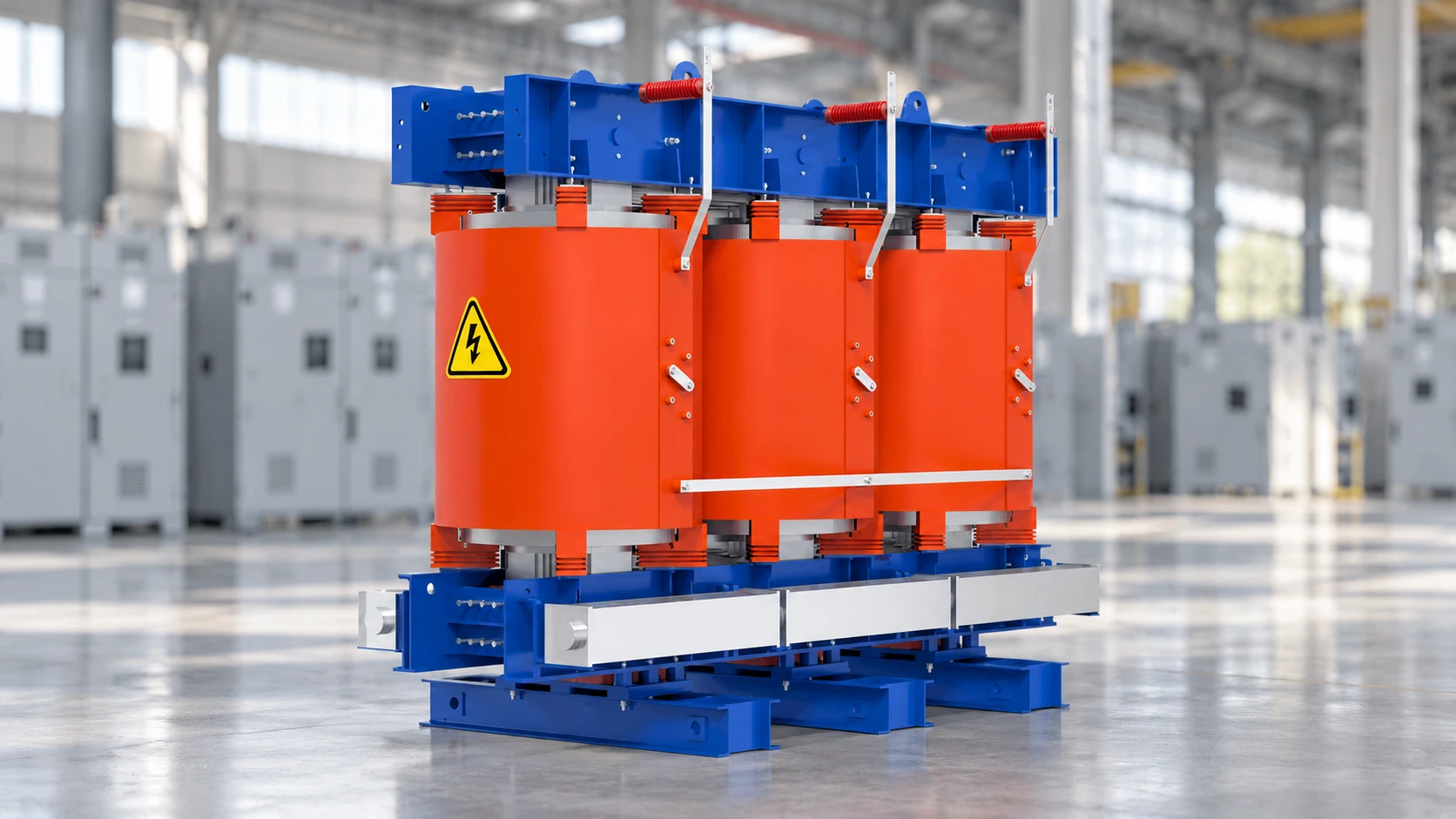
What is a 10kV epoxy resin cast dry-type power transformer?First clarify the product definition before discussing parameters
The 10kV epoxy resin cast dry-type power transformer belongs to the transformer category of power equipment, with the brand Qindian Zhicheng, and is used for voltage transformation in scenarios such as power stations, factories, and public buildings. If the product definition is unclear, subsequent communication on parameters such as capacity and cooling method will lack a common baseline.
What do the operating mode and epoxy resin cast structure of this dry-type transformer mean?
"Dry-type" means it does not rely on transformer oil as the insulation and heat dissipation medium;"Epoxy resin cast" means the windings are encapsulated and formed with epoxy resin, which is a specific structural form of dry-type transformers. Together, the two define the product form, but the cooling method and operating conditions need to be confirmed according to the specific model and cannot be inferred from the structural description alone.
Why must it first be confirmed as a 10kV voltage class dry-type transformer product before selection?
A parameter list is only meaningful when it is built around product facts. The voltage class is 10kV, which is the prerequisite for subsequently matching the distribution system and discussing capacity and operating conditions;Only after confirming that it is a dry-type transformer product can the fire protection and environmental requirements of the installation site be further compared. First lock in the identity of "10kV + epoxy resin cast + dry-type", and then communicate with Qindian Zhicheng about the selection parameters of the 10kV dry-type transformer, which is more efficient.
Where is it suitable for use?Scenarios such as factories, hospitals, airports, and power stations have different parameter concerns.
The 10kV epoxy resin cast dry-type power transformer has an oil-free structure, and the application scenarios listed in the product information include power stations, factories, hospitals, airports, universities, tunnels, chemical plants, etc. But "can be used" and "what to specify when requesting a quote" are two different things—for the same 10kV dry-type transformer, the information you need to provide differs depending on the scenario. The following compares key concerns by scenario.
Factory and power station scenarios: how to specify capacity requirements and operating conditions
For new production line power distribution in factories and auxiliary power distribution in power stations, the most frequently asked questions during inquiry are capacity and operating conditions: load characteristics, expected load rate, ventilation and heat dissipation conditions of the installation environment, and cooling method requirements. Product documentation specifies that the cooling method and operating conditions must be confirmed by model; these items should not be left until after the quotation, as they directly affect model selection and structural configuration. For power station scenarios, you should also clarify whether it is for auxiliary power distribution or other purposes, to avoid describing the voltage transformation requirements too vaguely.
Public buildings such as hospitals, airports, and universities: why fire safety and installation space should be stated first
Such public buildings are densely occupied and involve many acceptance procedures. The dry-type transformer's lack of oil leakage risk is a suitable advantage, but during inquiry you should proactively state: whether the installation location is close to areas with human activity, the available space dimensions of the power distribution room, the incoming and outgoing line methods, and whether the project is in the bidding stage and what technical documents are required. Airport and university campus projects have long cycles, and the completeness of technical documentation affects whether they can smoothly enter the bidding stage. It is recommended to directly ask during the inquiry which documents can be provided for the corresponding model.
Comparison of scenario focus points
| Scenario | Key points for inquiry |
|---|---|
| Factories, power stations | Capacity, load characteristics, ventilation and heat dissipation, cooling method (confirm by model) |
| Hospitals, airports, universities | Fire protection requirements, installation space, cable entry/exit method, scope of technical documentation |
| Harsh outdoor environments | Not applicable by default; environmental conditions must be specified and protection configuration confirmed with the manufacturer |
Boundaries of non-applicability: Epoxy resin cast dry-type transformers are not equivalent to units that can be installed directly in the open air. Whether they can be used in outdoor, high-humidity, dusty, or corrosive environments depends on the protection configuration and the specific model. The product documentation does not provide a conclusion that they are suitable for outdoor use by default; this must be confirmed by the manufacturer or other solutions considered.
Next steps: First, organize three things according to the scenario—where it will be installed, what load it will carry, and what the environmental conditions are—then submit them together with the 10kV voltage level and capacity requirements to the Qiandian Zhicheng team to confirm model matching and the scope of documentation.
What parameters must be provided before requesting a quotation?A checklist you can fill in directly
When requesting a quote for a 10kV dry-type transformer, the biggest worry is not the number of parameters, but missing key items—the manufacturer can only give an "approximate model," and the quote will have to be redone later. The checklist below is arranged in the order that affects model selection. Fill it out completely before sending it, and you can avoid one round of back-and-forth.
Voltage level, capacity requirements, equipment quantity: the three basic items that determine model matching
- Voltage level: This product is in the 10kV class, but the voltage combination on the high-voltage side and low-voltage side still needs to be specified, for example, high voltage 10kV and low voltage 0.4kV.Different voltage combinations change the winding design and insulation structure accordingly, directly affecting the model and quote.
- Capacity requirement (kVA)This is the core variable in model selection.Capacity is not safer the larger it is—oversized capacity means no-load losses and procurement costs rise together, and long-term low-load operation is not economical;if the capacity is too small, there is no margin under load growth or short-term impact. It is recommended to providethe calculated load or measured load, and state whether expansion is reserved, rather than directly quoting a "the bigger the better" number.
- Number of devices: single units and batches differ in production scheduling, delivery rhythm, and quotation structure. State the number of units clearly at once to avoid quoting per unit first and then changing it.
Installation site, cooling method, and operating conditions: the two items most easily overlooked yet affecting suitability
- Installation site: indoor or outdoor, space dimensions of the distribution room, fire protection and ventilation requirements.Epoxy resin cast dry-type transformers are suitable for scenarios such as power stations, factories, hospitals, airports, universities, and tunnels, but direct installation outdoors or in harsh environments requires separate confirmation of the protection and layout scheme; indoor configurations cannot be applied by default.
- Cooling method and operating conditions: the cooling method (such as natural cooling or forced air cooling) as well as ambient temperature, altitude, humidity, and whether long-term high-load operation occurs will all change the actual suitability of the product. These itemsmust be confirmed with the manufacturer according to the specific modeland cannot be assumed based on experience.The more specific the operating conditions are written, the better the manufacturer can determine whether the selected model matches, rather than first quoting a generic configuration and then reworking it.
Next steps: Organize the above six items into a one-page requirements specification, and send it together with the project location, expected delivery time, and whether technical documentation is needed to support bidding, so that the Qindian Zhicheng team can confirm the matching model and quotation accordingly. If a certain item cannot be determined temporarily (for example, load data has not yet been measured), clearly mark it as "to be determined" when requesting a quotation and state the expected confirmation time; this is more helpful to the other party in providing a usable preliminary plan than leaving it blank.
In which situations is it not recommended to choose it directly?And how to connect with Qindian Zhicheng with the checklist
Epoxy resin cast dry-type transformers have clear capability boundaries. Putting it into a mismatched scenario will result in later modification costs far higher than the equipment price difference saved earlier.
How to choose between dry-type and oil-immersed: first look at the fire protection requirements and maintenance conditions of the installation site
The recommended order of judgment is: first determine the installation site, then determine the maintenance method, and only then compare prices.
Situations where this product (dry-type) should be given priority:
- The distribution room is located inside a building, in a basement, or in a densely populated area, where fire protection and no oil leakage are mandatory requirements;
- Space is limited, and it is impossible to configure a separate oil pit, fire partition wall, and emergency oil drainage facilities for an oil-immersed transformer;
- In scenarios such as hospitals, airports, universities, tunnels, and chemical plants, daily inspection conditions are limited, and it is desirable to reduce oil-related management steps.
Situations where oil-immersed or other solutions should be evaluated first:
- Installed outdoors or in locations with harsh environmental conditions, where protection, moisture resistance, and heat dissipation conditions require special design—epoxy resin cast structures are not designed for direct installation in all harsh outdoor environments, and protection requirements must be confirmed with the manufacturer first;
- The project has expectations for overload capacity and thermal margin that exceed conventional levels, while the specific cooling method and operating conditions have not been verified by model;
- The budget is extremely tight, and the installation site itself already has the fire protection and civil engineering conditions for oil-immersed transformers—in this case, the fire protection advantage of dry-type is not needed, and the extra cost cannot bring corresponding benefits.
Situations where adding complexity is not worthwhile: For small distribution points with clear loads, conventional sites, and no special acceptance requirements, there is no need to add extra configurations for the sake of being "more advanced." First clarify the three items of voltage level, capacity, and usage scenario; the simpler the solution, the more controllable it is.
Contacting Qindian Zhicheng's technical team with a checklist is more effective than repeatedly comparing prices.
Price comparison can only compare numbers, not match. Before contacting them, organize the following items into a one-page document, and the communication efficiency will be noticeably different:
- Installation site: indoor/outdoor, floor level or basement, surrounding personnel density, local fire department's specific requirements for transformers;
- Electrical conditions: 10kV incoming line situation, required capacity, load characteristics and simultaneity factor, whether capacity expansion reservation is needed;
- Operating environment: ambient temperature, humidity, altitude, whether there are corrosive gases or dust;
- Project attributes: whether it is new construction or renovation, whether the tender requires complete technical documentation, what acceptance inspection stages are involved;
- Delivery and maintenancethe expected delivery milestone, whether the site has the conditions for hoisting and positioning, and who will be responsible for inspection afterward.
This checklist can directly deliver three things: confirming whether this 10kV epoxy resin cast dry-type transformer matches your site and load;clarifying items that need to be verified by model, such as cooling method and operating conditions;and the scope of technical documentation available for the corresponding model—when used for bidding or acceptance documents, it is best to ask about this in advance to avoid documentation gaps slowing down the process.
If item 1 on the checklist points to harsh outdoor environments or special fire protection exemption scenarios, don't rush to discuss price first; letting the technical team determine whether a different solution is needed is easier than making adjustments afterward.
Frequently Asked Questions
Q: Our distribution room is in the basement. Can we directly choose this dry-type transformer? Basements are usually a typical suitable scenario for dry-type transformers, but you also need to check the local fire protection authority's specific requirements for transformer installation, ventilation and heat dissipation conditions, and the temperature rise control corresponding to the capacity. Provide the site conditions and capacity together to Qindian Zhicheng for confirmation; this is more reliable than just looking at the three words "basement."
Q: Does that mean outdoor projects absolutely cannot use it? It cannot be generalized. The key lies in whether the protection rating, moisture-proof and dust-proof measures, and installation form match the model; these need to be confirmed according to the specific model, and conclusions cannot be drawn directly based on the product category.
Q: Is it enough for model selection to tell the manufacturer only the capacity and voltage level? Not enough. Capacity and voltage level only determine the basic specifications; the installation site, environmental conditions, and load characteristics will affect the choice of cooling method and operating conditions. Without this information, the manufacturer can only provide a general solution, and the purchaser bears the risk of subsequent changes.
Q: Technical materials are needed for bidding; can we request them now? You may submit your requirements, but the scope of materials that can be provided is subject to what the manufacturer can actually issue. It is recommended to state the purpose (bidding, submission for review, or acceptance inspection) during the initial contact so that the other party can organize the materials according to the corresponding model.
Learn more
If you are currently requesting a quotation for a 10kV epoxy resin cast dry-type transformer for a project, you may first compile the installation site, capacity requirements, operating environment, and project attributes into a one-page requirement description and submit it to the Qindian Zhicheng technical team.Based on this, we will help confirm the matching model, the cooling and operating conditions that need to be verified according to the model, and the scope of corresponding technical materials that can be provided, so that quotation and model selection can avoid an extra round of back-and-forth.