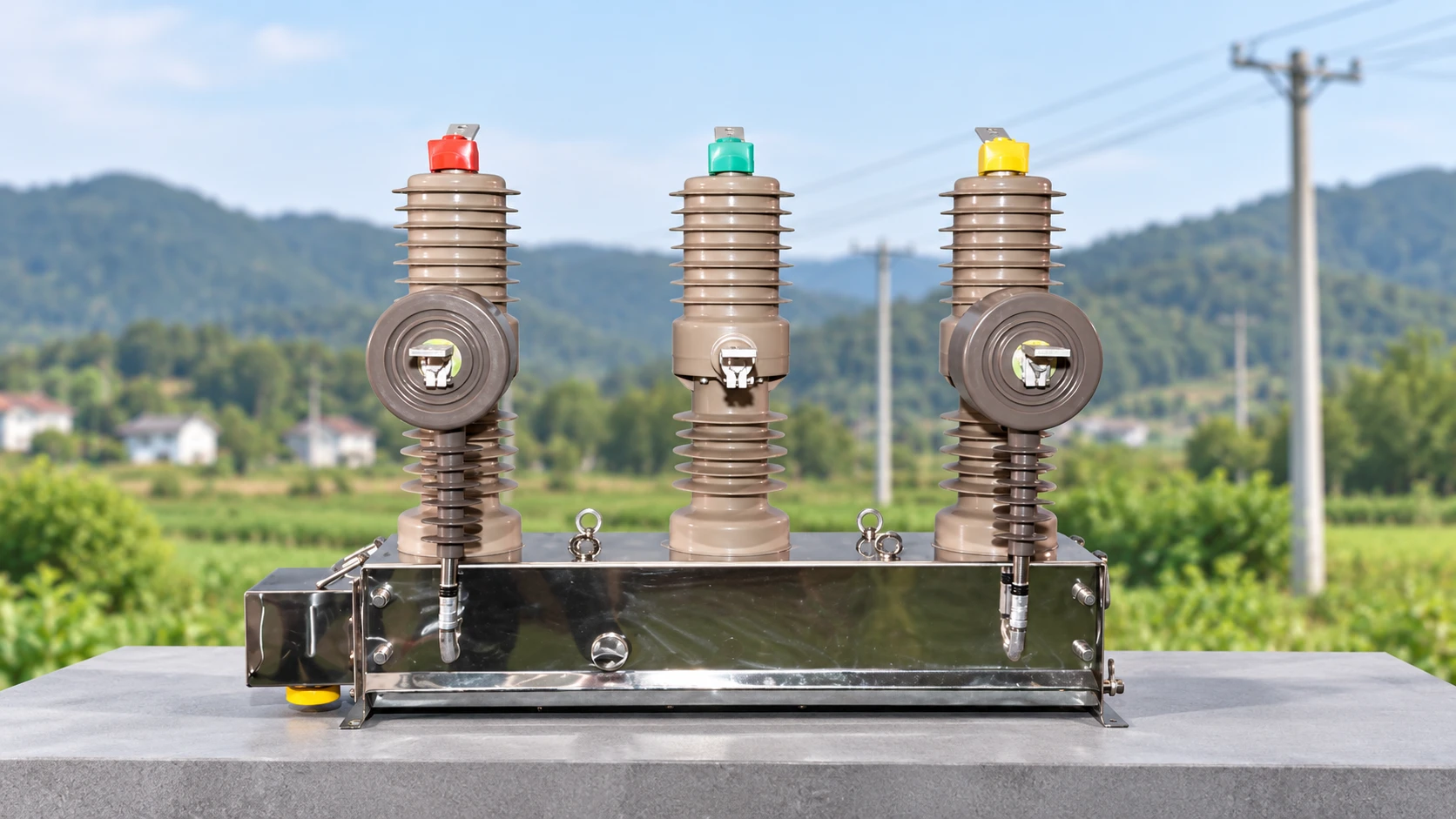
What is the responsibility of the 10kV outdoor vacuum circuit breaker body?Why are four-remote and recloser functions not included with the body by default?
The 10kV outdoor vacuum circuit breaker is designed according to the 10kV application level and installed on overhead distribution lines; the body undertakes primary-side switching and protection execution. The solid-sealed pole and outdoor silicone rubber structure are structural features of the body and are the foundation for outdoor installation adaptability, but they are not equivalent to automation capability.
Core capabilities of the body: overhead line sectioning, fault isolation, and branch load protection
What the body can complete is opening and closing operations, line sectioning, fault point isolation, and branch load protection. These capabilities do not include communication and automation functions. If, during procurement, "four-remote," "recloser," and "4G communication" are treated as standard body configurations when requesting quotations, it is easy to cause unclear configuration boundaries.
Overview of the functional dependency chain: four remote functions → controller + communication module + master station;Recloser → controller capability;PT → power supply and voltage signal
The judgment logic should be reversed: which component the required function falls on, and whether that component is already included in the quoted configuration. The four remote functions require the controller to collect and execute, the communication module to transmit, and the master station system to receive and issue commands;The recloser function depends on whether the controller has reclosing logic and setting capability;The PT affects the controller's power supply and voltage signal collection. The Ethernet/4G communication method, the scope of recloser functions, and the conditions for four remote access all need to be confirmed in combination with the controller, PT, and specific configuration; they cannot be assumed to be included with the unit by default.
When requesting a quotation, the function list should be broken down to the component level, and the configuration boundaries should be confirmed item by item with the supplier.
To achieve four-remote and 4G communication, besides the unit itself, do we also need to configure a controller and PT?Break down the dependencies item by item.
Yes, but "what to configure" depends on whether you want monitoring only without control, or complete four-remote plus protection. The unit itself is the switching actuator; four-remote and communication capabilities must be realized jointly by the controller, communication module, and voltage signal source, and PT is often the item most easily overlooked.
Four-remote and communication: controller, communication module, and master station protocol matching
Look at the dependencies item by item:
- Remote signaling, remote control:Depends on the controller. The body provides auxiliary contacts and the opening/closing circuit, but acquisition, encoding, and command execution are completed by the controller; the body does not include the controller.
- Telemetry: Depends on the controller and current transformer configuration.Current measurement is usually provided by current transformers on the body or on the controller side; which side is responsible must be confirmed according to the configuration.
- Remote adjustment: Depends on the controller supporting remote setting modification and the master station side having the corresponding function.
- 4G/Ethernet communication: Depends on the communication module.The module may be built into the controller or may be a standalone unit; it is necessary to clarify which form it is.
- Master station protocol matching: It is necessary to confirm that the protocols supported by the controller are consistent with your master station (such as IEC 60870-5-101/104, etc.), and to confirm whether the point table and the number of telemetry and remote signaling points meet the master station's requirements.When the protocols do not match, the communication module itself cannot compensate for it.
PT and operating power supply: The power supply method and the source of the voltage signal need to be confirmed
The PT has two functions on the pole: providing a voltage signal to the controller (for telemetry and energized/de-energized determination), and, in conjunction with power extraction, supplying power to the operating mechanism and the control circuit. Whether a PT must be equipped depends on:
- Whether the controller requires voltage measurement and voltage-based protection criteria;
- Whether the operating power is drawn from the PT, an external power supply, or another method;
- Whether the reclosing function requires check-no-voltage/check-synchronism.
Pole-mounted installation involves PT mounting brackets, high-voltage leads, fuse protection, and secondary wiring; these are usually not within the scope of supply for the circuit breaker itself and must be listed separately during inquiry.
Clearly define the configuration boundary during inquiry
It is recommended to specify item by item in the inquiry sheet: the body model and voltage level, whether the controller is included, the form of the communication module (built-in/independent) and its standard, the target protocol, the number of PTs and the power extraction method, the operating power scheme, and whether reclosing and its criteria are required. Marking the three states of "included/not included/to be confirmed" is more effective at avoiding later additions than vaguely writing "equipped with four remotes." Specifically for the 10kV overhead line sectionalizing scenario, regarding which items can be simplified and which cannot be omitted, it is recommended to provide the line conditions and master station requirements to the Qindian Zhicheng team for configuration matching confirmation.
Which scenarios are suitable for configuring four-remote and recloser functions?Which scenarios are not recommended for adding complexity
Four-remote and recloser functions change the way faults are handled and operations and maintenance are performed. Whether they are worth configuring depends on whether there are operating conditions on the line that require remote sectionalizing and automatic reclosing to shorten outage time.
Suitable scenarios: sectionalizing of long lines in counties, branch protection in industrial parks, and requirements related to grid connection of photovoltaic/small hydropower
Overhead lines in counties are long and have many branches, and manual line patrol after a fault is time-consuming. Installing 10kV outdoor vacuum circuit breakers at key sectionalizing points, combined with four-remote for remote opening/closing and status monitoring and with reclosers to restore transient faults, can reduce line patrol trips and narrow the scope of outages. When branch loads in industrial parks grow rapidly, installing protection switches at branch points can keep branch faults outside the main line. This is the core value of branch load protection. Grid connection points of distributed photovoltaic and small hydropower belong to grid-connection-related equipment requirements, but the protection and reclosing strategies in grid connection scenarios must be confirmed in accordance with grid connection requirements and cannot simply copy the settings of overhead lines.
Not recommended scenarios: for multiple circuits of incoming and outgoing lines at concentrated load points, ring main unit/switchgear station solutions should be selected
In scenarios with concentrated load points and multiple incoming and outgoing circuits, ring main unit or switching station solutions are more suitable in terms of the number of bays, busbar connections, and centralized protection; replacing them with a single outdoor vacuum circuit breaker makes the wiring and subsequent expansion unsuitable. In scenarios with short lines, few branches, and relatively fast manual handling after a fault, the investment in controllers, PTs, communications, and setting coordination brought by adding four-remote and recloser functions cannot be offset by a corresponding reduction in outage time. If communication coverage, the method of obtaining control power, and responsibility for subsequent setting maintenance are not yet clear, it is also inadvisable to deploy four-remote first; otherwise, after configuration, no one will set the values and no signals will be transmitted back, leaving the complexity to operations and maintenance.
Next step confirmation: After organizing the line length, number of branches, whether grid-connected power sources are included, communication coverage, and allowed outage duration, confirm whether the controller, PT, and recloser configuration match the operating conditions.
How should model selection and quotation be implemented?First lock in voltage and current, then specify the configuration boundaries according to the five groups
Model selection is not about choosing a model first, but about first determining the "hard constraints" such as voltage and current, and then discussing secondary configuration. The order is reversed; no matter how detailed the quotation is, it cannot be compared side by side.
First confirm the system voltage and current parameters, then discuss the secondary configuration.
When the system is 10kV, checking the rated voltage of the ZW32-12 must come down tothe maximum operating voltagethis item, rather than only looking at the number "10kV"—the system nominal voltage, equipment rated voltage, and maximum operating voltage are three different concepts. During inquiry, the supplier should be required to specify each item in the technical parameter table and explain its correspondence with the system voltage level of this project. If this step is not aligned, no matter how carefully the controller and transformers are selected later, it may all be in vain.
The current parameters that must be confirmed for branch line selection include at least:rated current(based on the maximum continuous load current of the branch with a reasonable margin),rated short-circuit breaking current(verified against the short-circuit current level at the branch point),rated short-time withstand current and its duration。 These three items determine whether the unit itself can be used and must not be filled in by the quoting party by default. Four-remote, 4G communication, and recloser functions are configurations outside the unit itself and need to be confirmed in conjunction with the controller, PT, and specific configuration, so they must be discussed only after the voltage and current are locked in.
The inquiry sheet shall list the five groups separately: the unit itself, secondary configuration, communication, structure, and installation.
When quotes from several parties differ greatly, the difference usually lies in the configuration boundaries not being clearly specified. It is recommended to list the inquiry sheet in five separate groups so that each supplier quotes under the same scope:
- Main body: model, rated voltage/maximum operating voltage, rated current, breaking current, pole structure (e.g., embedded poles)
- Secondary configuration: controller model and functions, transformer ratio and quantity, whether recloser function and operating logic are included
- Communication: specific interface type for Ethernet or 4G, protocol, whether communication module and antenna are included
- Structure: Outdoor silicone rubber external insulation, enclosure protection, and installation method
- Installation: Whether the scope of supply includes brackets, accessories, commissioning, and training
For each group, the supplier is required to state "included/not included" rather than only quoting a total price. This way, quotation differences will be directly exposed in configuration differences rather than hidden in vague items.
How to choose in the end: conclusion boundaries
If the project involves overhead line sectionalizing, fault isolation, or branch load protection, and the voltage and current parameters can already be clearly determined, simply list and compare according to the above five groups;If a centralized load point requires multiple incoming and outgoing circuits and centralized protection, a ring main unit/switchgear station solution is more suitable, and there is no need to add complexity to this product. If the reclosing strategy involves grid connection of photovoltaic or small hydropower, the protection coordination requirements on the grid-connection side must first be clarified, and then the recloser function configuration can be determined.
When the parameter definitions and configuration boundaries are uncertain, you can ask Qindian Zhicheng to help confirm a matching solution based on your system conditions, and then finalize the inquiry sheet accordingly.
Frequently Asked Questions
Q: The system is 10kV. Is it enough to write only "rated voltage 10kV" on the quotation? Not enough. It is also necessary to check whether the maximum operating voltage covers the actual operating level of the system, and to require the supplier to state the corresponding relationship; otherwise, adaptability cannot be judged.
Q: Can the rated current of a branch line be quoted according to the main line current? Not recommended. The branch should be selected according to its own maximum continuous load current, and the short-circuit current at that point should be checked separately; otherwise, it may be oversized and wasteful or undersized and insufficient.
Question: Should four-remote and 4G communication be included in the body quotation? It is recommended to list them separately. They depend on the specific configuration of the controller, PT, and communication module; mixing them into the body will make each supplier's quotation scope inconsistent.
Question: Can the lowest bidder be selected directly? First check whether the five configuration groups are complete and whether inclusion/exclusion is clearly stated. For low prices with unclear configuration boundaries, the subsequent additional costs are often higher.
Learn more
If you are preparing an inquiry for an overhead line sectionalizing or branch protection project, you can organize the system voltage level, maximum continuous load current of the branch, short-circuit current level, master station protocol requirements, and whether reclosing is needed, and send them to the Qindian Zhicheng team. We will help verify the matching boundaries between the main unit and the secondary configuration according to your operating conditions, and then form an inquiry list that can be directly used for price comparison.